Why So Many VA Claims Get Denied — or Come Back Too Low
The VA denied roughly 30% of disability claims in recent years. Millions more come back with ratings lower than the veteran’s actual condition warrants. The frustrating reality: most of these outcomes aren’t because veterans don’t deserve benefits. They’re because of avoidable mistakes in how claims are filed, documented, and presented.
After working with hundreds of veterans through the VA claims process, the coaches at Veterans Educating Veterans have seen the same errors surface over and over. These mistakes cost veterans years of back pay, lower monthly compensation, and access to benefits that were rightfully theirs all along.
Here are the most common — and costly — mistakes veterans make when filing VA disability claims, and exactly what to do instead.
Mistake #1: Filing Without a Current Diagnosis
The VA requires three things to grant service connection: a current diagnosis, an in-service event or injury, and a medical link (nexus) connecting the two. The most common oversight is filing a claim without an up-to-date diagnosis from a licensed medical professional.
Veterans often know they’re suffering — chronic back pain, sleep problems, mental health struggles — but haven’t gotten formally diagnosed, especially if they’ve avoided the healthcare system since separating. Filing a claim without a diagnosis gives the VA an easy reason to deny: no diagnosed condition, no rating.
What to do instead: Before filing, see a doctor. Get the diagnosis documented in your medical records. Then file. The diagnosis is the foundation everything else rests on.
Mistake #2: Downplaying Symptoms at the C&P Exam
The Compensation and Pension (C&P) exam is often the single most important event in a veteran’s claim. A VA examiner — typically a doctor or nurse practitioner — evaluates the veteran and writes a report that raters rely heavily on to assign a percentage.
Veterans are trained to be stoic. “I’m fine” and “I manage” are answers that feel natural in any medical setting. At a C&P exam, they’re devastating. The examiner documents what you say. If you minimize your symptoms, the rating assigned reflects that minimization.
What to do instead: Be honest about your worst days, not your average days. If your condition flares unpredictably, describe those flares. If pain limits your sleep, your work, your relationships — say so. The VA rates the real impact of your condition, and the examiner needs to hear about it in full.
Mistake #3: Missing Secondary Conditions
Every service-connected condition can potentially unlock additional claims through secondary service connection. This is one of the most underutilized strategies in VA claims — and one of the highest-value opportunities for veterans stuck at mid-tier ratings.
Common secondary connections include:
- Sleep apnea secondary to PTSD (PTSD disrupts sleep architecture; apnea often follows)
- Depression or anxiety secondary to chronic pain conditions
- Radiculopathy (nerve pain) secondary to a back or neck condition
- Migraine headaches secondary to tinnitus
- Erectile dysfunction secondary to PTSD or spine conditions
- Diabetes secondary to Agent Orange exposure (for eligible veterans)
Each secondary condition that receives a rating adds to your combined disability percentage. Veterans who have claimed only their most obvious, direct-service conditions are often leaving significant rating points — and hundreds of dollars per month — unclaimed.
What to do instead: Review every service-connected condition you have and ask: what else has this caused or made worse? Then document the medical connection with a strong nexus letter from a qualified provider.
Mistake #4: Submitting a Weak or Generic Nexus Letter
A nexus letter is a medical opinion connecting your current condition to your military service. It’s often the single piece of evidence that determines whether a claim is approved or denied.
Many veterans submit nexus letters that don’t meet the VA’s legal standard — “at least as likely as not” — because the letter is too brief, too vague, or written by a provider who doesn’t understand VA claims requirements. A letter that says “this veteran has back pain that may be related to service” is likely to be insufficient. A strong nexus letter references the veteran’s service records, cites the specific in-service event or exposure, explains the medical rationale in detail, and uses the precise “at least as likely as not” language the VA looks for.
What to do instead: Work with a provider experienced in writing VA nexus letters — ideally one who understands the VASRD and the specific diagnostic codes involved. Generic language gets generic results.
Mistake #5: Filing Claims Piecemeal Instead of Strategically
Many veterans file one claim at a time — a knee, then a back, then PTSD — without a broader strategy. The problem: the VA’s combined ratings formula means the order and grouping of your claims affects your final combined rating. Filing multiple claims together, in a coordinated way, often produces a better outcome than filing the same conditions one at a time over years.
Additionally, filing piecemeal means each claim goes through a separate decision cycle. That’s more C&P exams, more waiting periods, more opportunities for errors in the record.
What to do instead: Map out all your service-connected conditions — primary and secondary — before filing. Develop a comprehensive claims strategy that accounts for the combined ratings formula and files conditions in a way that maximizes your overall rating.
Mistake #6: Missing the Effective Date
Your effective date — the date the VA uses to calculate retroactive pay — is typically the date you filed your claim. Every day you delay filing costs you back pay. A veteran who waits 12 months to file a claim that’s eventually approved at 70% loses approximately $21,000 in retroactive compensation at current rates.
Veterans also sometimes miss the opportunity to claim back to their separation date. If you file within one year of your discharge, and your claim is approved, your effective date can be your separation date — potentially opening years of retroactive pay.
What to do instead: File now. Even if your documentation isn’t perfect, filing establishes your effective date. You can supplement with additional evidence after filing without losing your date.
Mistake #7: Accepting a Denial Without Appealing
Many veterans receive a denial letter, assume the VA is correct, and move on. This is a costly mistake. A significant percentage of initial claim decisions contain errors — incorrect diagnostic codes, failure to consider all submitted evidence, or C&P exams that didn’t reflect the veteran’s actual condition.
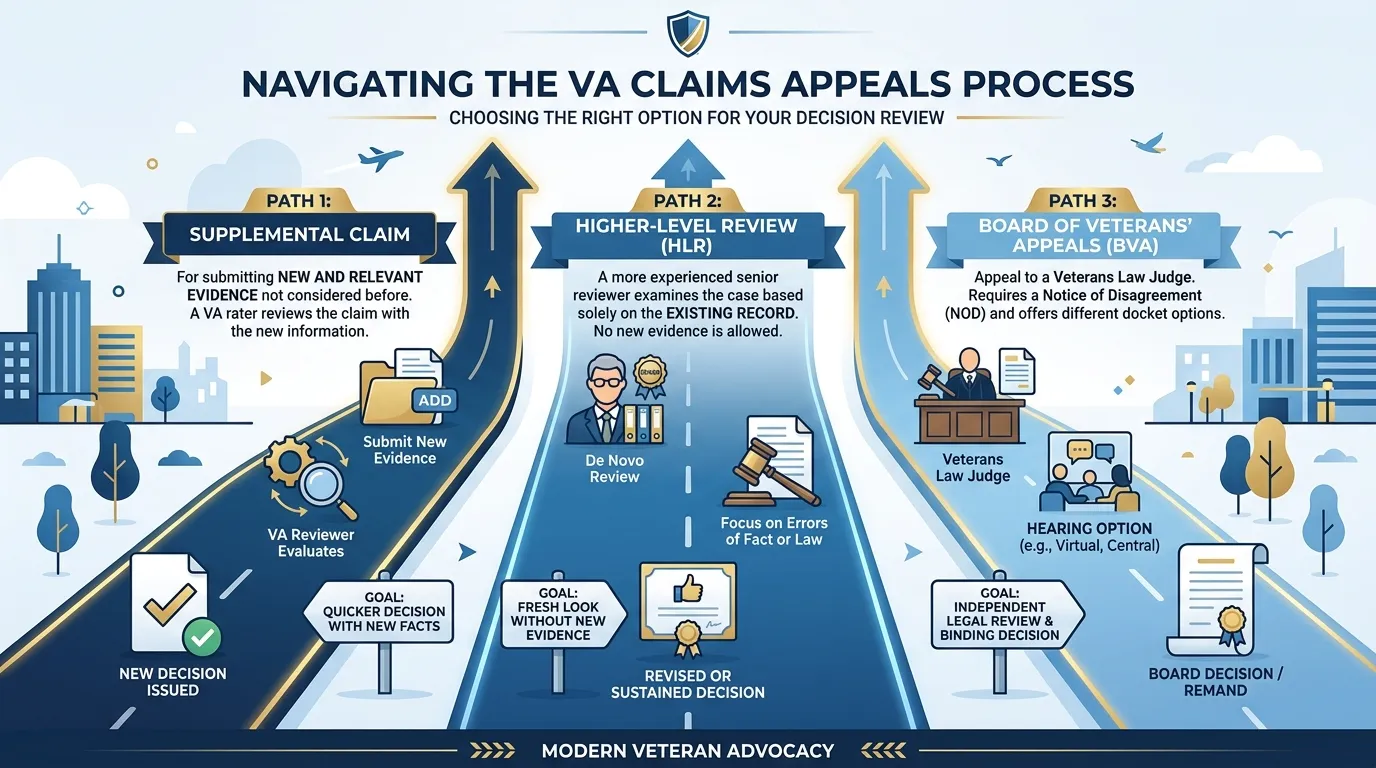
The VA’s AMA (Appeals Modernization Act) system provides three lanes for challenging a decision:
- Supplemental Claim: Submit new and relevant evidence not previously considered
- Higher-Level Review: Request a more senior rater review the same evidence
- Board of Veterans’ Appeals: Appeal directly to a Veterans Law Judge
Choosing the right lane — based on what caused the denial — makes a significant difference in both processing time and outcome.
What to do instead: Read your decision letter carefully. Identify the specific reason for denial. Then pursue the appeal lane that directly addresses that reason. Supplemental Claims with new evidence are often the fastest path to a successful reversal.
Mistake #8: Not Requesting a Higher-Level Review After a Low Rating
Getting approved is only half the battle. A service-connected condition at the wrong rating percentage can cost a veteran thousands of dollars per year. The difference between a 50% and 70% PTSD rating, for example, is over $650 per month — more than $7,800 annually.
Veterans who receive a rating that doesn’t reflect their actual level of impairment have options. A Higher-Level Review or Supplemental Claim with updated medical evidence showing increased severity can result in a rating increase without starting the process over from scratch.
What to do instead: Compare your assigned rating criteria against the VASRD criteria for your condition. If your symptoms meet the criteria for a higher rating and your current rating doesn’t reflect that, challenge it.
Mistake #9: Not Pursuing Individual Unemployability (TDIU)
Veterans with a single condition rated at 60% or higher, or a combined rating of 70% or higher with at least one condition at 40%+, may qualify for Individual Unemployability (TDIU) if their conditions prevent substantial gainful employment. TDIU pays at the 100% rate — even if your combined percentage is lower.
Many veterans in the 60-90% range who cannot work full-time are unaware of TDIU or have been told they don’t qualify without a proper evaluation. TDIU is one of the most underutilized benefits in the VA system.
What to do instead: If your service-connected conditions prevent you from working or severely limit your employment, discuss TDIU eligibility with someone who understands the criteria.
Mistake #10: Going It Alone
The VA system is complex, the regulations run thousands of pages, and the margin for error is significant. Most veterans who try to navigate the system alone — or rely solely on a VSO with a heavy caseload — leave significant compensation on the table.
This isn’t a criticism of veterans’ capability. The VA system is genuinely difficult. It was designed by lawyers interpreting regulations written by other lawyers. Understanding how raters actually make decisions, how C&P examiners think, and how to build evidence that meets the VA’s legal standards requires experience that takes years to develop.
The coaches at Veterans Educating Veterans have that experience — because they’ve used it on their own claims first. Every coach on the VEV team is a combat veteran who worked with VEV to pursue their own VA disability claims before joining the team. They’ve sat where you’re sitting. They know what works.
Frequently Asked Questions About VA Claim Denials
Why did the VA deny my disability claim?
VA claims are denied for several reasons: no current diagnosis, insufficient evidence of an in-service event, a weak or absent nexus linking your condition to service, or an examiner’s opinion that your condition is less likely than not related to your service. Reading your rating decision letter carefully will identify the specific reason — and that reason determines your best path to appeal.
How long do I have to appeal a VA denial?
Under the AMA, you have one year from the date of the rating decision to file an appeal. After one year, you lose certain appeal options, though you can still file a Supplemental Claim with new and relevant evidence at any time.
Can I reopen a denied VA claim?
Yes. If you have new and relevant evidence — a new medical diagnosis, updated records, or a stronger nexus letter — you can file a Supplemental Claim at any time. The key is the evidence must be genuinely new (not previously submitted) and must be relevant to the issue that caused the denial.
What is the most common reason VA claims are denied?
The most common reasons are: insufficient nexus (no medical link between the condition and service), no current diagnosis, and insufficient evidence of an in-service event. The C&P exam also plays a major role — examiner opinions that don’t support service connection frequently result in denials.
Does having a VSO help with VA claims?
VSOs (Veterans Service Organizations) provide free assistance and can be valuable resources. However, VSO representatives often carry very large caseloads and may not have the capacity to build a truly comprehensive strategy for every veteran. For veterans with complex claims, multiple conditions, or a history of denials, more intensive support often produces better results.
You Deserve the Rating You Earned
Filing a VA disability claim shouldn’t feel like fighting a second battle. But for too many veterans, the process is opaque, slow, and unforgiving of mistakes that could have been avoided with the right guidance.
At Veterans Educating Veterans, our coaches have walked the exact path you’re on. They’ve been denied. They’ve appealed. They’ve built the evidence and won. And they’re here to teach you how to do the same — with a 90% favorable decision rate and a simple promise:
You Only Pay When You Get Paid.
Start with a free strategy session today and find out exactly where your claim stands and what opportunities you may be missing.