What Is a VA Disability Rating?
A VA disability rating is a percentage the Department of Veterans Affairs assigns to represent how much a service-connected condition affects your ability to function. Ratings run from 0% to 100% in 10-percentage-point increments — 0%, 10%, 20%, 30%, and so on — and directly determine how much monthly compensation you receive.
The rating system traces back to the VA Schedule for Rating Disabilities (VASRD), a federal regulation that sets the criteria for every recognized condition. Each condition has a diagnostic code, and within that code are specific criteria — typically based on symptom frequency and severity — that map to a rating percentage.
Here’s the key thing most veterans misunderstand: the VA does not simply add your individual ratings together. A veteran with a 50% rating and a 30% rating does not have an 80% combined rating. The VA uses a specific mathematical formula that always produces a lower number than the sum of the parts.
How the VA Combined Ratings Formula Works
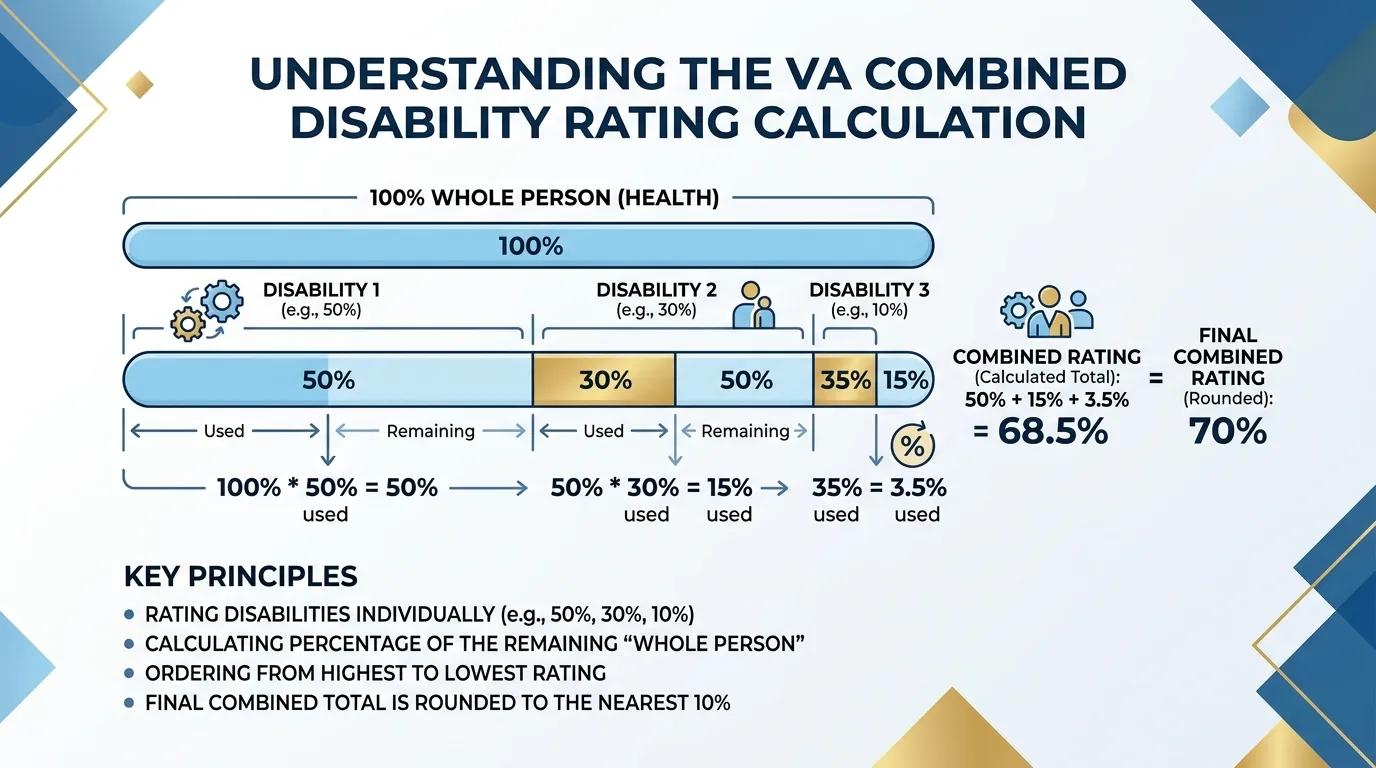
The VA’s combined ratings table is based on the concept of a “whole person.” The idea: if you already have a 50% disability, you only have 50% of a “whole” person left to be further disabled. A second 30% rating is then applied to that remaining 50%, not to the full 100%.
Step-by-Step: Calculating Your Combined VA Rating
- Start with your highest rating. Suppose you have a 50% rating. This means 50% of you is “disabled,” leaving 50% of a “whole” person.
- Apply your next rating to the remaining whole person. A 30% rating applied to the remaining 50% = 30% × 50 = 15 additional percentage points.
- Add the results. 50 + 15 = 65% combined disability.
- Round to the nearest 10. The VA rounds 65 up to 70%, because VA rules round anything from 65–74 up to 70.
- Repeat for additional ratings. If you have a third condition, apply that rating percentage to whatever “whole person” remains after your first two conditions.
This is why so many veterans feel stuck. You can accumulate multiple conditions and still see your combined rating budge only a few percentage points. Understanding this math is the first step toward building a smarter claims strategy.
VA Rounding Rules
After applying the combined ratings formula, the VA rounds the final number:
- 1–4% → rounds down to 0%
- 5–14% → rounds to 10%
- 15–24% → rounds to 20%
- And so on — anything from X5 to X4 of the next decade rounds up to the next 10-point increment.
The only exception: if your final combined rating reaches 95% or higher, the VA rounds up to 100%.
VA Disability Pay Chart 2026
Your monthly VA compensation depends on your combined disability rating and your dependent status. The VA adjusts rates annually based on the Cost of Living Adjustment (COLA). For 2026, rates reflect the most recent COLA increase.
The table below shows approximate monthly rates for veterans with no dependents:
| Rating |
Monthly Pay (No Dependents, 2026) |
| 10% |
~$175 |
| 20% |
~$346 |
| 30% |
~$537 |
| 40% |
~$774 |
| 50% |
~$1,102 |
| 60% |
~$1,395 |
| 70% |
~$1,759 |
| 80% |
~$2,044 |
| 90% |
~$2,297 |
| 100% |
~$3,737 |
Veterans with dependents (spouse, children, or dependent parents) receive additional monthly payments. At 100% P&T (Permanent and Total), veterans also unlock access to CHAMPVA healthcare for their families, Chapter 35 DEA education benefits for dependents, and property tax exemptions in most states.
What Each VA Disability Rating Means
Beyond the dollar amount, your rating has practical implications across your entire benefits picture.
0% Rating
A 0% rating means the VA has service-connected the condition but considers it non-compensable — the condition is not severe enough to warrant monthly pay. However, a 0% rating is still valuable: it establishes service connection, making it easier to claim secondary conditions and increases later.
10%–40% Ratings
At this range, veterans receive monthly compensation but may not yet qualify for additional benefits like vocational rehabilitation at the highest tiers. Veterans in this range often have significant room to increase their rating by properly documenting symptom severity or adding secondary conditions.
50%–70% Ratings
A 50% or higher rating can make veterans eligible for individual unemployability (TDIU) if the conditions prevent substantial gainful employment. TDIU pays veterans at the 100% rate even without a 100% combined rating — a critical benefit that many veterans in this range are unaware of.
100% Rating
The highest rating, unlocking maximum monthly compensation and the full suite of VA benefits. Veterans with a 100% Permanent and Total (P&T) rating receive additional stability — the VA cannot reduce their rating without clear evidence of sustained improvement.
How the VA Determines Your Rating: The Claims Process
The VA uses a three-part standard to grant and rate a service-connected disability:
- Current diagnosis. You must have a current, diagnosed medical condition.
- In-service event or injury. There must be a documented incident, exposure, or event during military service that caused or contributed to the condition.
- Nexus (medical link). A medical professional must connect the in-service event to the current diagnosis. This nexus letter is often the make-or-break element in a claim.
Once service connection is granted, the VA rater uses the VASRD diagnostic codes to assign a percentage. The assigned percentage depends on objective findings (range of motion measurements, lab values, mental status exam results) and the veteran’s reported symptoms.
This is where many claims lose value. Raters look at the evidence of record on the date of rating. If a veteran downplays symptoms during a Compensation and Pension (C&P) exam — something many veterans do out of habit — the VA may assign a lower rating than the veteran’s condition warrants.
Common Reasons Veterans Receive Lower Ratings Than They Deserve
- Downplaying symptoms at the C&P exam. Veterans are trained to push through pain. Saying “I’m fine” at a C&P exam can result in a rating that doesn’t reflect real-world impact.
- Missing secondary conditions. Many conditions cause or aggravate other conditions. Tinnitus can cause sleep apnea. Back injuries cause radiculopathy. These secondary connections often go unclaimed.
- Incomplete medical records. Gaps in service treatment records mean the VA may not have evidence of in-service events even when they occurred.
- Weak or missing nexus letters. A generic nexus letter is often insufficient. A strong nexus letter specifically references the veteran’s records and provides a rationale meeting the “at least as likely as not” standard.
- Incorrect diagnostic code applied. Raters are human. Sometimes the wrong diagnostic code is used, resulting in a lower maximum rating ceiling than the correct code would allow.
How to Increase Your VA Disability Rating
If your current rating doesn’t reflect your actual level of disability, you have options. This is exactly what the coaches at Veterans Educating Veterans help veterans navigate every day.
1. File for an Increased Rating
If a service-connected condition has worsened since your last rating, you can file a Supplemental Claim citing new and relevant evidence — typically an updated medical evaluation showing increased severity.
2. Add Secondary Conditions
Secondary service connection allows you to claim conditions caused or aggravated by an already service-connected disability. Common secondaries include sleep disorders secondary to PTSD, depression secondary to chronic pain, and radiculopathy secondary to back conditions. Each secondary condition that gets approved adds to your combined rating.
3. Appeal Denied or Under-Rated Claims
If the VA denied a claim or assigned a rating lower than what the evidence supports, you can appeal through the AMA (Appeals Modernization Act) process via three lanes: Supplemental Claim, Higher-Level Review, or Board of Veterans’ Appeals. Choosing the right lane and submitting the right evidence at the right time is critical.
4. Pursue Individual Unemployability (TDIU)
Veterans rated at 70% or higher with one condition (or 60%+ combined with one condition at 40%+) who cannot hold substantially gainful employment can apply for TDIU — which pays at the 100% rate.
5. Work With Veterans Who Know the System
The VA system is complex, the regulations are dense, and raters are overworked. Having an experienced guide who has personally navigated the system makes a measurable difference.Coaches at Veterans Educating Veterans achieved their 100% ratings with the help of VEV before joining the team — they’ve lived exactly what you’re going through.
Frequently Asked Questions About VA Disability Ratings
Can the VA reduce my disability rating?
Yes, but only under specific conditions. The VA must show clear and unmistakable evidence of sustained improvement in your condition. If you are rated at 100% P&T (Permanent and Total), or if your rating has been in place for five or more years (a “protected rating”), the VA faces a much higher standard before it can reduce your benefits. Regular C&P exams or failure to report for scheduled exams can trigger reduction reviews.
How long does it take to get a VA disability rating?
Initial decisions typically take 3–6 months, though the VA’s backlog can extend this. Appeals take longer — sometimes 1–3 years depending on the lane chosen. Filing complete, well-documented claims from the start significantly reduces processing time and avoids the appeals cycle entirely.
What is the difference between a combined rating and an individual rating?
An individual rating applies to a single service-connected condition. A combined rating is the overall disability percentage calculated from all your conditions using the VA’s whole-person formula. Your monthly payment is based on the combined rating, not any single individual rating.
Does a 100% rating mean 100% disabled?
Not necessarily in a literal sense. A 100% combined rating can be reached through the whole-person formula with multiple conditions. Alternatively, some veterans reach 100% through Individual Unemployability (TDIU) — rated at the 100% pay level because they cannot work, even if their combined percentage is lower.
What is the VA disability rating for PTSD?
PTSD is rated under the General Rating Formula for Mental Disorders (38 CFR Part 4, Diagnostic Code 9411). Ratings range from 0% to 100% depending on occupational and social impairment. A 70% PTSD rating — the most common higher-tier rating — reflects significant symptom severity impacting work and social relationships. Many veterans who qualify for a higher rating are initially assigned 50% or 70%; a properly documented appeal can secure 100%.
How do I calculate my combined VA rating?
You can calculate it manually using the whole-person formula (described above) or use the VA’s combined ratings table. Start with your highest individual rating, apply each subsequent rating to the remaining whole person, add the results, then round to the nearest 10. For most veterans, an online combined ratings calculator gives the same result with less math.
Take the First Step Toward the Rating You’ve Earned
Understanding the VA disability rating system is the foundation of every successful claim. But knowledge alone isn’t enough — you need evidence, documentation, and a strategy built around how raters actually make decisions.
At Veterans Educating Veterans, our coaches are combat veterans who achieved 100% VA disability ratings themselves using these exact methods. We’ve helped hundreds of veterans navigate the system, secure secondary connections, appeal bad decisions, and reach the ratings they deserve — with a 90% favorable decision rate.
Our program works on a simple principle:
You Only Pay When You Get Paid. No upfront fees. No risk. Just results.
Get started with a free strategy session today and find out exactly where your rating stands and what opportunities you may be leaving on the table.