
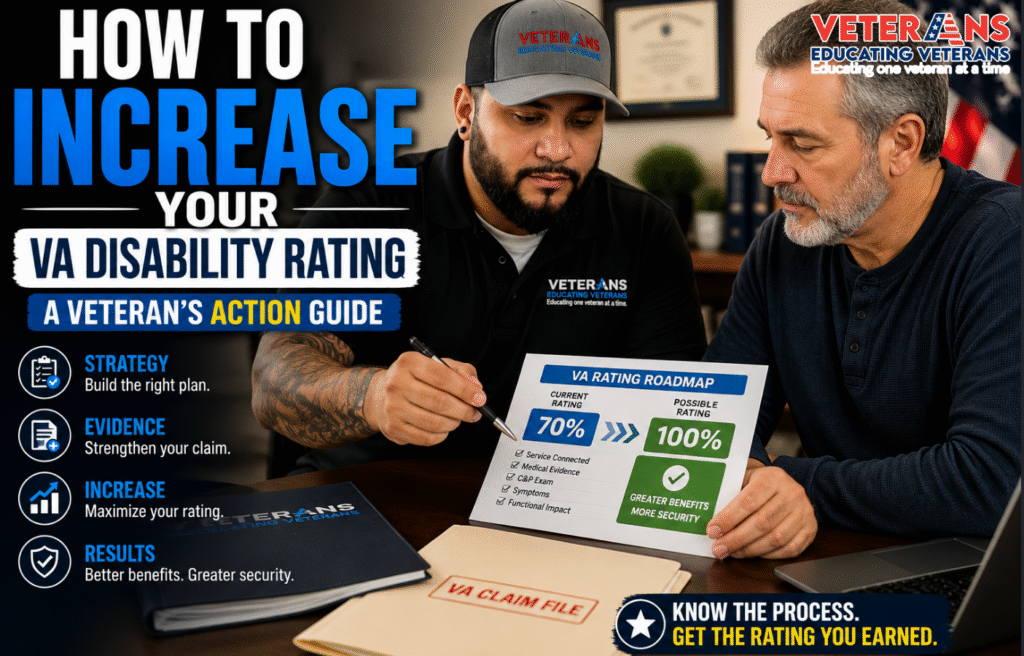
Why Veterans Get Stuck at the Same Rating for Years
If you’re reading this, you probably already have a VA disability rating — and you know it doesn’t fully reflect what you’re living with. Maybe you’ve had the same rating for three years. Maybe the VA recently denied your claim for an increase. Maybe you hit 70% and feel like 100% is out of reach.
You’re not imagining it. Veterans routinely receive ratings that undercount their actual level of disability. The system is built on evidence, documentation, and legal criteria — and veterans who don’t know how to build and present that evidence consistently get less than they’ve earned.
The good news: most veterans who aren’t at 100% have real pathways to increase their rating. Here’s how.
Step 1: Understand Why Your Current Rating Isn’t Higher
Before you can increase your rating, you need to understand why it’s where it is. Pull up your most recent rating decision letter and read it carefully. Every denial or lower-than-expected rating cites a specific reason:
- Service connection not established — the VA didn’t find sufficient evidence linking your condition to military service
- Condition rated lower than expected — the VA used a specific diagnostic code and applied criteria that placed you at a lower rating tier
- C&P exam findings unfavorable — the examiner’s notes didn’t support a higher rating, often because symptoms were underreported
- Missing nexus — no medical opinion connecting your condition to service was in the record
- Secondary conditions unclaimed — related conditions were never filed
Each of these has a specific solution. The approach that works for a nexus gap is different from the approach for a low C&P exam finding. Diagnosing the problem first saves you from pursuing strategies that won’t move the needle on your specific situation.
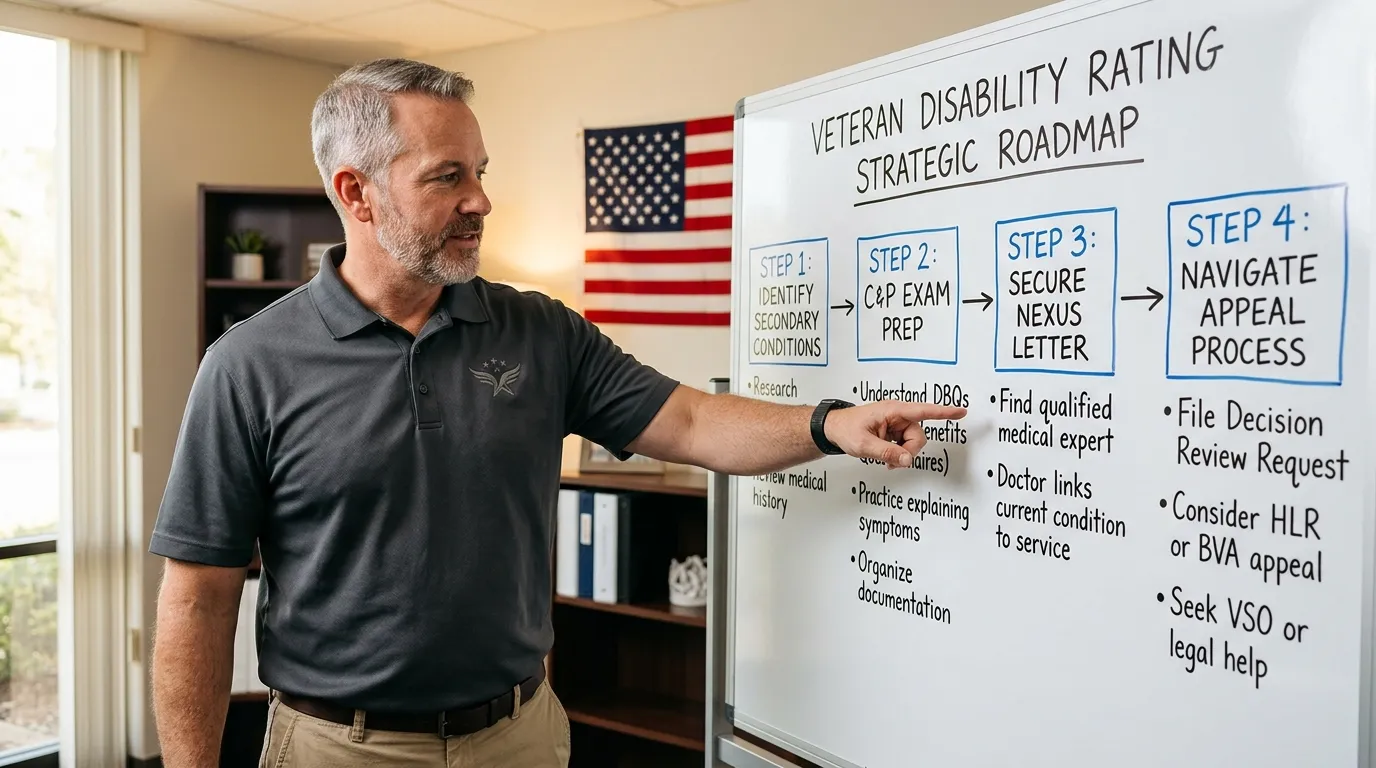
Step 2: Identify Unclaimed Secondary Conditions
Secondary service connection is one of the most powerful — and most underused — strategies for increasing a VA disability rating. The VA allows veterans to claim conditions that were caused or aggravated by an already service-connected disability. Each approved secondary condition adds to your combined rating.
If you have a primary service-connected condition, ask yourself: what else has this caused or made worse? For a deeper breakdown, see VEV’s guide to secondary conditions to back pain.
Common Secondary Conditions Worth Claiming
- PTSD → Sleep apnea, depression, anxiety, substance use disorder, erectile dysfunction
- Chronic back pain → Radiculopathy (leg or arm nerve pain), depression, hip arthritis
- Tinnitus → Sleep disorders, headaches/migraines, depression, anxiety
- Knee conditions → Hip and ankle arthritis (compensatory gait issues)
- TBI → Migraines, cognitive impairment, depression, sleep disorders
- Type 2 diabetes (Agent Orange) → Peripheral neuropathy, erectile dysfunction, hypertension
To establish a secondary condition, you need a current diagnosis and a medical opinion (nexus letter) stating the secondary condition is “at least as likely as not” caused or aggravated by your primary service-connected disability. The key difference from a primary claim: you don’t need a separate in-service event. The link goes from your existing service-connected condition to the new condition.
Step 3: File for an Increased Rating with Updated Evidence
If a service-connected condition has worsened since your last rating decision, you can request an increase. The VA will schedule a new Compensation and Pension (C&P) exam to re-evaluate severity.
This is where many veterans make a critical mistake: they request an increase without preparing for the C&P exam, and the exam result doesn’t reflect the actual severity of their condition. Before filing, use the VA Disability Calculator to understand how another approved condition could affect your combined rating.
How to Prepare for a C&P Exam That Actually Reflects Your Condition
- Know your diagnostic code criteria. Look up the VASRD diagnostic code for your condition. Each rating tier (10%, 20%, 30%, etc.) has specific criteria — range of motion measurements, frequency of symptoms, level of occupational and social impairment. Know exactly what the next tier requires and document how your condition meets it.
- Document your worst days, not your average days. Examiners evaluate you based on what you report. If your condition fluctuates, describe the bad days. The VA rates the overall impact of your condition — including flares and bad episodes.
- Bring a buddy statement. Written statements from family members, friends, or coworkers who observe how your condition affects your daily life are powerful supplemental evidence. They provide context a medical record can’t.
- Don’t minimize. Veterans are trained to push through pain and project strength. At a C&P exam, that instinct works against you. Be direct and honest about how your condition affects your sleep, work, relationships, and daily activities.
- See your private doctor first. Getting a recent evaluation from your own provider — with detailed notes on symptom frequency and severity — creates a contemporaneous medical record that can corroborate your C&P exam findings.
Step 4: Get a Strong Nexus Letter
Whether you’re establishing a new secondary condition or supporting an increased rating, the quality of your nexus letter matters enormously. A weak letter can sink an otherwise solid claim. A strong letter can win one that seemed impossible.
A strong nexus letter:
- Is written by a licensed medical professional with experience in VA claims
- References the veteran’s specific service records and medical history
- Uses the precise legal standard: “at least as likely as not” (50% or greater probability)
- Provides a detailed rationale explaining the medical basis for the opinion
- Addresses and rebuts any unfavorable VA examiner opinions already in the record
Generic letters (“this veteran has PTSD that may be service-related”) are routinely given little weight. Specific, well-reasoned letters are the difference between a denial and an approval.
Step 5: Appeal a Low Rating or Denial
If your most recent rating decision was lower than what the evidence supports, don’t accept it. Under the AMA (Appeals Modernization Act), you have three appeal options within one year of a decision:
- Supplemental Claim — submit new and relevant evidence not previously considered. This is the fastest lane and the best choice when you have a new nexus letter, updated medical records, or buddy statements that weren’t in the original claim.
- Higher-Level Review — request that a more senior VA rater review the same evidence. No new evidence can be submitted, but this is effective when the original rater made a clear error in applying the law or failed to consider evidence already on file.
- Board of Veterans’ Appeals — appeal to a Veterans Law Judge. This is the most thorough review but also the slowest (often 2-4 years). Best for complex cases where legal arguments matter most.
The right lane depends entirely on why you were denied or under-rated. Choosing the wrong lane wastes time. Choosing the right one — with the right evidence — often results in a reversal. If you are trying to avoid preventable errors, review VEV’s article on common VA disability claim mistakes.
Step 6: Explore Individual Unemployability (TDIU)
If your service-connected conditions prevent you from working in a substantially gainful position, Individual Unemployability (TDIU) lets you receive compensation at the 100% rate — even if your combined rating is lower. This is one of the most valuable benefits in the VA system, and one of the most commonly overlooked.
TDIU Eligibility Requirements
You may qualify for TDIU if you have:
- A single service-connected condition rated at 60% or higher, OR
- A combined rating of 70% or higher, with at least one condition rated at 40% or higher
Some veterans can also qualify for TDIU under “extraschedular” provisions even if they don’t meet the percentage thresholds, if the totality of their conditions prevents them from working.
To apply, file VA Form 21-8940 (Veteran’s Application for Increased Compensation Based on Unemployability). Supporting evidence typically includes a private medical opinion, statements from employers, and detailed documentation of how symptoms affect your ability to perform work-related tasks.
Step 7: Consider Unemployability vs. Pursuing 100%
For veterans between 70% and 90%, the question often becomes: is it better to pursue TDIU or continue stacking conditions toward a 100% combined rating?
The answer depends on your specific situation:
- TDIU is faster — if you qualify, it gets you to 100% pay without requiring additional approved conditions
- 100% P&T (Permanent and Total) offers more stability — once rated at 100% P&T, the VA cannot reduce your rating without extraordinary evidence of sustained improvement
- 100% P&T unlocks additional benefits — CHAMPVA for dependents, DEA education benefits for dependents, property tax exemptions in most states, commissary access
Many veterans pursue both simultaneously — applying for TDIU while also filing secondary conditions that could push the combined rating to 100%.
Frequently Asked Questions About Increasing Your VA Rating
How do I request an increase in my VA disability rating?
File a Supplemental Claim (VA Form 20-0995) with new and relevant evidence showing your condition has worsened or was under-rated. The VA will typically schedule a new C&P exam to re-evaluate severity. You can file online at va.gov or by mail.
How long does a VA disability increase take?
The VA targets 125 days for Supplemental Claims, though current processing times vary. Complex cases with multiple conditions or extensive medical records often take longer. Filing a complete, well-documented claim from the start is the single best way to speed up processing.
Can the VA lower my rating if I ask for an increase?
Yes — when you file for an increase, the VA conducts a fresh evaluation that could theoretically result in a lower rating if your condition has improved. However, certain ratings are protected: ratings in place for 5+ years cannot be reduced without clear evidence of sustained improvement, and ratings in place for 20+ years cannot be reduced at all. Ratings assigned as P&T are also protected from routine reduction.
What is the easiest VA disability to get service-connected?
Certain conditions are presumptively service-connected for veterans who served in specific locations or were exposed to specific hazards, including Agent Orange exposures (herbicide), Camp Lejeune water contamination, burn pit exposures (PACT Act), and certain radiation exposures. Presumptive conditions don’t require a nexus letter — service and diagnosis are sufficient for approval.
What happens if I reach 100% VA disability?
At 100%, you receive maximum monthly compensation plus access to a suite of additional benefits: CHAMPVA healthcare for dependents, Chapter 35 DEA education benefits for dependents, commissary and exchange access, property tax exemptions in most states, and more. At 100% Permanent and Total (P&T), your rating is protected from reduction.
The Veterans Educating Veterans Difference
Increasing your VA disability rating isn’t just about filing paperwork — it’s about building the right evidence, presenting it correctly, and knowing which strategies to deploy in which order. That knowledge comes from experience.
Every coach at Veterans Educating Veterans achieved a 100% VA disability rating themselves before joining the team. They’ve navigated denials, built nexus letters, survived C&P exams, and won increases using exactly the strategies described here. Then they made it their mission to teach other veterans how to do the same.
Our results speak for themselves: a 90% favorable decision rate and an average increase of $800 per month for veterans we work with — typically within 4 months.
And our model is simple: You Only Pay When You Get Paid. No upfront fees. No risk.
Schedule your free strategy session today — find out exactly where your rating stands, what you may be leaving unclaimed, and what it would take to increase it.