
If you’re a disabled veteran, your VA benefits don’t stop with you. The VA provides a wide range of additional compensation and programs specifically for your spouse, children, and other dependents — and most veterans aren’t collecting everything they’re entitled to.
This guide covers every major VA benefit available to military dependents and spouses: added disability compensation, health care programs, education benefits, survivor benefits, and more. Understanding what your family qualifies for could mean thousands of dollars per year in additional support.
Not sure if you’re claiming everything your family deserves? Veterans Educating Veterans works with disabled veterans nationwide to identify missed claims and increase ratings. Get started — You Only Pay When You Get Paid.
Does the VA Pay Extra If You Have Dependents?
Yes. If you have a VA disability rating of 30% or higher, the VA increases your monthly disability compensation when you add qualifying dependents to your award. The more dependents you have, the higher your monthly payment.
Qualifying dependents include:
- A spouse (including a surviving spouse of a prior marriage under certain conditions)
- Children under age 18
- Children between 18-23 who are enrolled full-time in school
- Children of any age who became permanently incapable of self-support before age 18
- Dependent parents (in some cases — these follow a separate income-based formula)
To add dependents to your award, you file VA Form 21-686c (Declaration of Status of Dependents). If a child is in school, you also file VA Form 21-674. The added compensation is retroactive to the date of your claim, so file as soon as your rating reaches 30% or higher.
How Much Extra Does the VA Pay for Dependents?
Dependent pay rates change annually with cost-of-living adjustments. For 2026, the additional monthly amounts for veterans rated 30% or higher include:
- Spouse only: Roughly $60-$180 per month depending on your rating (higher ratings get larger increases)
- Spouse + one child: Adds another $25-$30 per child above the spouse rate
- Each additional child: A smaller increment for each qualifying child
- Aid and Attendance for spouse: If your spouse requires regular aid and attendance from another person, a significantly higher additional rate applies
For exact 2026 compensation tables by rating percentage and dependent status, visit the VA’s official compensation rate page or use the VA’s online compensation calculator.
VA Health Care for Dependents and Spouses
VA health care itself is primarily for eligible veterans, not their family members. However, several programs provide health care access for military dependents and spouses — and many veterans overlook these entirely.
CHAMPVA (Civilian Health and Medical Program of the VA)
CHAMPVA is the VA’s health insurance program for certain dependents and survivors. It covers eligible individuals who are NOT otherwise covered by TRICARE (military health care). You may qualify for CHAMPVA if you are:
- The spouse or child of a veteran rated permanently and totally disabled (100% P&T) for a service-connected condition
- The surviving spouse or child of a veteran who died from a VA-rated service-connected disability
- The surviving spouse or child of a veteran who died in the line of duty
CHAMPVA covers most health care costs at 75% after a deductible, with a similar structure to standard health insurance. Enrollees are responsible for 25% up to an annual cap.
Important: You cannot use CHAMPVA if you qualify for Medicare Part A or Part B — in that case, Medicare is your primary coverage. However, once you have Medicare coverage, CHAMPVA can act as secondary insurance, covering many out-of-pocket costs Medicare doesn’t pay.
A 100% Permanent & Total (P&T) disability rating may make eligible dependents qualify for CHAMPVA. If you’re not yet rated 100% P&T, Veterans Educating Veterans can help you get there. See how — You Only Pay When You Get Paid.
TRICARE for Eligible Military Families
If you are a retired servicemember (not just a disabled veteran), your family may be eligible for TRICARE coverage. TRICARE and CHAMPVA cannot be used together — the VA programs are designed for veterans who don’t have access to TRICARE. If your family has TRICARE, they don’t qualify for CHAMPVA.
VA Education Benefits for Military Dependents
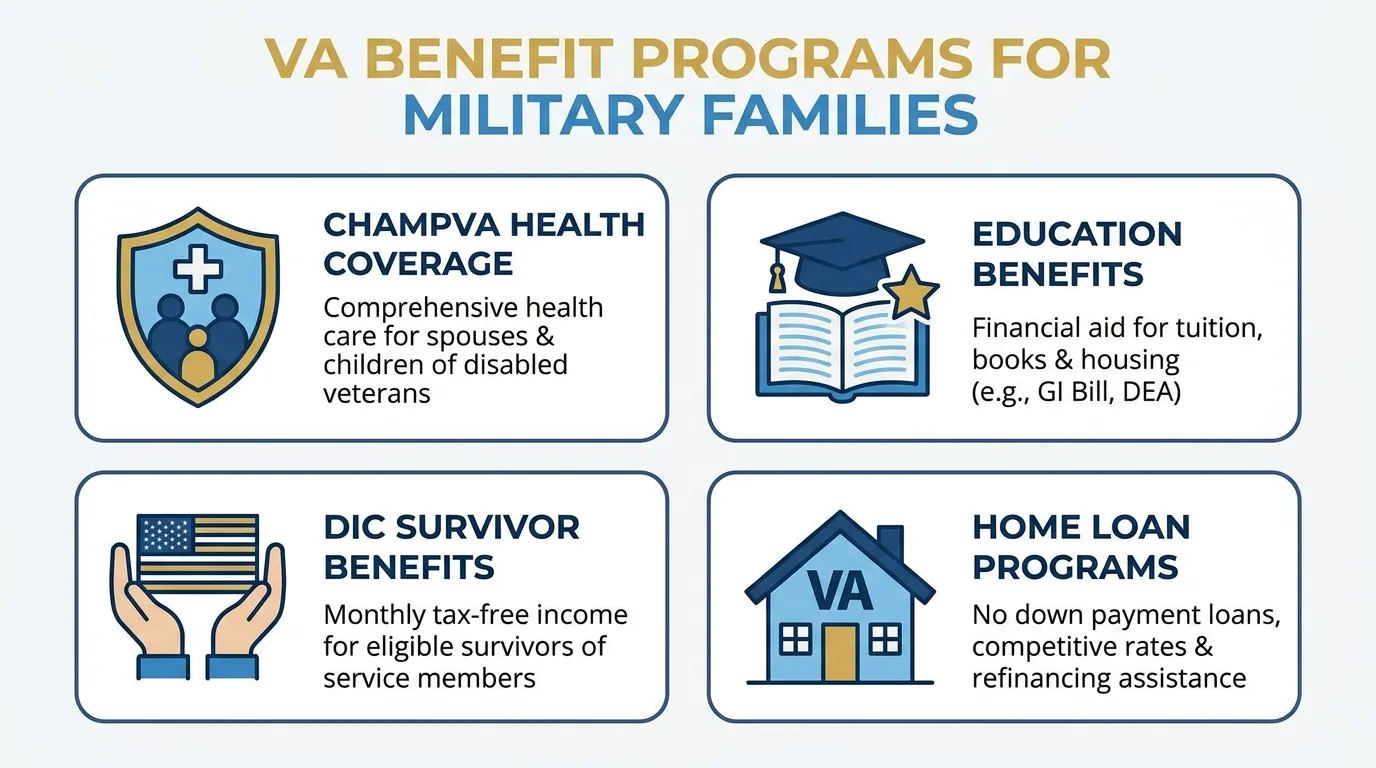
The VA provides two key education benefit programs specifically for dependents of disabled or deceased veterans:
Chapter 35 — Dependents’ Educational Assistance (DEA)
Chapter 35 provides education and training benefits to spouses and children of veterans who are permanently and totally disabled from a service-connected condition, or who died of a service-connected disability. Eligible dependents can receive monthly stipends for approved education programs, including:
- College or university degrees
- Vocational or technical programs
- Apprenticeships and on-the-job training
- Licensing and certification testing fees
The DEA program pays a monthly benefit rate (set by the VA annually) for up to 36 months of education or training. Spouses have 10 years from the date of the veteran’s disability rating or death to use the benefit. Children generally must use it between ages 18 and 26.
Fry Scholarship
The Fry Scholarship provides Post-9/11 GI Bill benefits to children and surviving spouses of servicemembers who died in the line of duty on or after September 10, 2001. This is separate from the DEA and is often more generous in terms of benefit amounts, covering tuition, housing, and book stipends at a level comparable to the Post-9/11 GI Bill.
Surviving spouses have a choice: use the Fry Scholarship OR transfer to the Survivors’ and Dependents’ Educational Assistance (Chapter 35) — but not both simultaneously.
VA Home Loan Benefits for Surviving Spouses
Surviving spouses of veterans who died from service-connected disabilities may be eligible for VA home loan benefits, including access to zero-down-payment mortgages without private mortgage insurance (PMI). Eligibility generally requires that the veteran died from a service-connected condition, or that the veteran was totally disabled and the surviving spouse wasn’t remarried (or remarried after age 57).
Disabled veterans themselves are already eligible for VA home loans with a disability rating of any percentage. Additionally, veterans with a VA disability rating of 10% or higher can have their VA funding fee waived, potentially saving an estimated $3,000–$15,000+ on a home purchase, depending on the loan amount and other factors.
DIC — Dependency and Indemnity Compensation for Surviving Spouses
Dependency and Indemnity Compensation (DIC) is a monthly tax-free payment to eligible survivors of veterans who died from service-connected conditions. DIC is one of the most valuable — and most commonly missed — VA survivor benefits available to military spouses.
Who Qualifies for DIC?
You may qualify for DIC as a surviving spouse if your veteran spouse:
- Died from a disease or injury connected to military service
- Died from a VA-rated service-connected condition while on active duty, active duty for training, or inactive duty training
- Was continuously rated totally disabled (100% or TDIU) for at least 10 years before death (even if the cause of death wasn’t service-connected)
- Was rated totally disabled for at least 5 years from the date of discharge and died within that period
- Was a former POW rated totally disabled for at least 1 year before death
How Much Is DIC?
The base DIC rate is set by Congress and adjusted annually. In 2026, the base rate is approximately $1,600 per month. Additional amounts are added if:
- You have dependent children
- You require Aid and Attendance
- You are housebound
- Your veteran was rated totally disabled for 8 or more years before death (transitional benefit)
DIC payments are not taxable, and they do not count as income for most federal programs. Surviving spouses who also receive VA pension may receive whichever benefit is higher, but generally cannot receive both simultaneously.
If your veteran spouse had a high disability rating, DIC eligibility planning starts now — not after death. Contact Veterans Educating Veterans to understand the long-term impact of a 100% P&T rating on your family’s future benefits. Schedule your strategy session.
Aid and Attendance and Housebound Benefits for Veterans with Dependents
If you are a 100% disabled veteran who requires the regular aid and attendance of another person — or who is essentially housebound — you may qualify for additional monthly compensation on top of your base rating. This directly benefits your dependent spouse by keeping you at home rather than in institutional care, and increases the household income that supports your family.
Aid and Attendance is also available to surviving spouses receiving DIC, as noted above. If your surviving spouse will need regular in-home care or assisted living, the Aid and Attendance addendum to DIC can significantly increase monthly support.
VA Vocational Rehabilitation for Dependent Children (Chapter 31)
Chapter 31 (Veteran Readiness and Employment, or VR&E) is primarily for veterans with service-connected disabilities that limit their ability to prepare for, obtain, or maintain suitable employment. In some cases, eligible veterans may also receive independent living services when employment is not currently feasible. VR&E is not a direct benefit for spouses or dependent children, but veterans can discuss their eligibility and available services with a VR&E counselor
Life Insurance Options for Military Families
The VA provides several life insurance programs relevant to veteran families:
- Veterans Affairs Life Insurance (VALife): VALife is the VA’s current life insurance program for eligible veterans with service-connected disabilities. Veterans who already have Service-Disabled Veterans Life Insurance (S-DVI) may keep their existing coverage, but new applicants generally apply for VALife.
- Veterans’ Mortgage Life Insurance (VMLI): For severely disabled veterans with VA-adapted housing grants. Covers the outstanding mortgage balance if the veteran dies.
- Servicemembers’ Group Life Insurance (SGLI) Family Coverage (FSGLI): Extends SGLI coverage to spouses and dependent children of servicemembers on active duty.
Unlike most other VA benefits, life insurance programs require active enrollment and premium payments. Review your coverage annually to ensure your family is protected.
VA Pension and Survivors Pension
VA Pension is a needs-based benefit for wartime veterans with limited income and assets who are permanently and totally disabled (not necessarily from a service-connected condition). If you receive VA Pension, the amount is increased if you have dependents.
Survivors Pension (formerly “Death Pension”) is available to surviving spouses and unmarried children of deceased wartime veterans who had limited income and assets. This is separate from DIC — it does not require the death to be service-connected, making it accessible even when the veteran’s death was unrelated to military service.
Frequently Asked Questions: VA Benefits for Dependents and Spouses
Can I add a common-law spouse as a dependent for VA benefits?
Yes, in most states. The VA recognizes common-law marriages if they are valid under the laws of the state where the couple lived. You’ll need to provide evidence of the common-law marriage, including a signed statement and corroborating documentation.
What happens to my dependent benefits if I get divorced?
If you divorce, you must notify the VA immediately. Your former spouse will be removed from your dependency award, and your monthly compensation will be reduced. Failure to report a divorce is considered fraud. Your ex-spouse does not retain VA dependent benefits after divorce (though a former spouse may qualify for certain benefits under USFSPA for military retirees in separate situations).
Can my dependent children receive VA benefits after they turn 18?
Yes, if they are enrolled full-time in school. File VA Form 21-674 (School Attendance) to continue receiving the dependent add-on for a child between 18 and 23 who is a full-time student. Once they complete school or leave full-time enrollment, you must notify the VA.
Does my spouse’s income affect my VA disability compensation?
No. VA disability compensation is not income-based. Your rating determines your base payment, and adding a qualifying dependent increases it — regardless of your spouse’s income or your combined household income. (VA Pension, however, IS income-based and your combined income does affect it.)
If I increase my VA rating, do my dependent benefits increase automatically?
Yes. If you already have dependents on your award and your rating increases to 30% or higher (or increases from 30% to a higher rate), your dependent add-on amounts increase automatically based on the new rating. No additional action is required for existing dependents already on file.
Ready to maximize the VA benefits your family deserves? Veterans Educating Veterans has helped veterans across the country reach higher ratings and unlock the full range of dependent benefits. Get started today — You Only Pay When You Get Paid.