

A scars VA rating can come down to details many veterans overlook: whether the scar is painful, whether the skin breaks down, where it is located, how large it is, and whether it affects motion or function. If a scar came from a service injury, burn, surgery, shrapnel wound, laceration, or treatment for a service-connected condition, the VA may evaluate it separately from the underlying condition.
If your scar is painful, unstable, disfiguring, or tied to a service injury, contact Veterans Educating Veterans to learn how our veteran-led coaching team helps veterans document claims the right way.
This guide explains how the VA looks at scar ratings, what evidence matters, what to photograph and measure, and what to discuss with a clinician before a Compensation and Pension exam or private medical evaluation. This is education, not legal advice. The goal is to help you understand the evidence the VA needs so you can advocate for yourself with a stronger record.
How the VA Rates Scars
The VA rates most scars under the skin section of the rating schedule, 38 CFR 4.118. The rating depends on the type of scar and the symptoms it causes. The most common paths are:
- Diagnostic Code 7800: scars or disfigurement of the head, face, or neck.
- Diagnostic Code 7801: scars not on the head, face, or neck that involve underlying soft tissue damage.
- Diagnostic Code 7802: scars not on the head, face, or neck that do not involve underlying soft tissue damage but cover a large enough area.
- Diagnostic Code 7804: scars that are painful or unstable.
- Diagnostic Code 7805: other disabling effects of scars, such as limited motion or other functional loss.
That means a small scar may still matter if it hurts every day, repeatedly opens, limits movement, or sits on the face, head, or neck. A large scar may matter because of its size or tissue damage even if it is not constantly painful. The key is matching the evidence to the correct rating path.
What Is a Painful Scar for VA Rating Purposes?
A painful scar is not just a scar that looks bad. It is a scar that causes pain, tenderness, burning, stinging, pulling, hypersensitivity, numbness with painful flares, or pain when clothing, gear, pressure, motion, or weather irritates the area. Under Diagnostic Code 7804, the VA can rate painful or unstable scars based on how many qualifying scars are present.
| Number of painful or unstable scars | Possible VA rating under DC 7804 |
|---|---|
| One or two scars | 10 percent |
| Three or four scars | 20 percent |
| Five or more scars | 30 percent |
The rating schedule also says that if one or more scars are both unstable and painful, the VA adds 10 percent to the evaluation based on the total number of painful or unstable scars. That detail matters. A veteran with a scar that is painful and also repeatedly loses its skin covering should make sure both facts are documented clearly.
What Is an Unstable Scar?
An unstable scar is a scar where, for any reason, there is frequent loss of covering of skin over the scar. In plain English, the skin breaks down. It may reopen, scab, peel, crack, drain, or fail to stay healed. This can happen with scars over joints, scars irritated by clothing or prosthetics, burn scars, surgical scars, or scars in high-friction areas.
Veterans often underreport unstable scars because the scar may look fine on the day of the exam. Do not rely on one appointment to tell the whole story. If the scar opens and closes over time, document the pattern.
- How often does the skin break down?
- How long does it take to heal?
- Does it bleed, drain, crust, peel, or scab?
- Does movement, work gear, braces, boots, clothing, or weather make it worse?
- Have you needed bandages, topical medication, antibiotics, or medical visits?
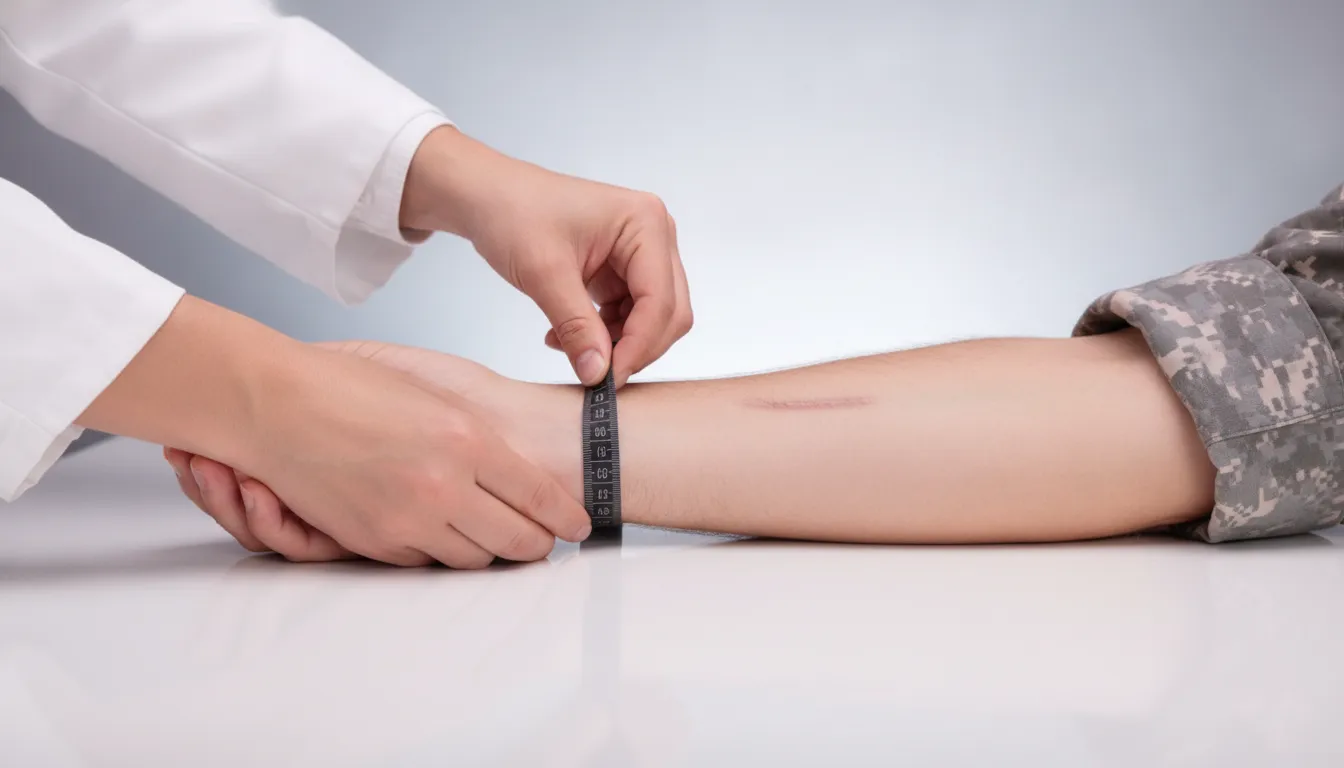
How Size and Location Affect a Scars VA Rating
Size and location matter because different diagnostic codes apply to different scar types. The VA looks at whether the scar is on the head, face, or neck; whether it involves underlying soft tissue damage; and how much surface area is affected.
Scars not on the head, face, or neck with tissue damage
Under Diagnostic Code 7801, scars not of the head, face, or neck that are associated with underlying soft tissue damage may be rated based on area. The rating schedule lists thresholds starting at at least 6 square inches, or 39 square centimeters, and increasing at larger areas.
This can apply to deeper burn scars, surgical scars with underlying tissue damage, shrapnel injuries, traumatic wounds, or other scars where the damage is not limited to the surface of the skin.
Large superficial scars
Under Diagnostic Code 7802, scars not of the head, face, or neck that are not associated with underlying soft tissue damage can still receive a rating if the affected area is large enough. The schedule lists 144 square inches, or 929 square centimeters, as the area threshold for a 10 percent rating.
Head, face, or neck scars
Scars of the head, face, or neck can be evaluated for disfigurement under Diagnostic Code 7800. The VA looks at characteristics such as length, width, elevation or depression, adherence to underlying tissue, pigmentation changes, abnormal texture, missing soft tissue, and induration or inflexibility. The VA may also consider visible or palpable tissue loss and distortion or asymmetry of facial features.
Do not assume a face or neck scar is too small to matter. The VA’s disfigurement criteria include specific measurements and visible characteristics. Good photographs and a careful exam are important.
What Veterans Should Photograph
Photos help when they are clear, dated, and tied to the symptoms you are describing. A single blurry photo is weak evidence. A small set of organized photos can show what the scar looks like over time and during flare-ups.
Photograph the following when relevant:
- The scar from straight on and from the side.
- The scar with enough surrounding body area to show exact location.
- A close photo showing texture, color change, elevation, depression, or breakdown.
- Any scabbing, cracking, peeling, drainage, or reopened skin during unstable periods.
- Any effect on motion, such as pulling across a joint or tightness when bending.
- Any irritation caused by braces, boots, uniforms, helmets, prosthetics, or work gear.
Use good lighting. Avoid filters. Do not use graphic images unless they are necessary to show the problem. If you photograph a flare-up, write down the date, what triggered it, how long it lasted, and what treatment you used.
What Veterans Should Measure
The VA Scars and Disfigurement Disability Benefits Questionnaire instructs examiners to provide measurements in centimeters and area measurements in square centimeters. For non-linear scars, the form tells examiners to measure length and width at the widest points.
Before an exam, a veteran can prepare by knowing where the scars are and how many need to be evaluated. You do not need to replace the clinician’s exam, but you should be ready to point out each scar and explain its history and symptoms.
- Length: the longest visible part of the scar.
- Width: the widest point, especially for non-linear scars.
- Area: length times width for simple estimates, with clinician documentation preferred.
- Location: exact body area, side, and whether it crosses a joint or facial feature.
- Number: each painful or unstable scar should be identified separately.
Need help organizing the evidence before you file or appeal? Use the VA Disability Calculator to understand how ratings combine, then contact VEV for education-focused coaching.
What to Discuss With a Clinician
A strong scar claim usually needs more than a photo. It needs a medical record that connects the scar to service and documents the current symptoms. If you see a VA or private clinician, be direct and specific.
Discuss:
- The original injury, burn, surgery, shrapnel wound, laceration, or treatment that caused the scar.
- Whether the scar is painful, tender, hypersensitive, numb, burning, or pulling.
- Whether the scar is unstable, meaning the skin frequently loses its covering.
- Whether the scar limits motion, strength, grip, gait, facial movement, work tasks, or daily activities.
- Whether the scar adheres to underlying tissue or feels tight during movement.
- Whether there is underlying soft tissue damage, muscle involvement, or nerve symptoms.
- Whether you use bandages, creams, medications, compression, or other treatment.
If the scar came from surgery for a service-connected condition, tell the clinician that history. If it came from an in-service accident or injury, identify the incident, approximate date, unit, duty station, and treatment record if you have it. If the scar worsened over time, explain that timeline.
Service Connection for Scars
The VA generally needs three things: a current scar or residual symptoms, an in-service event or service-connected medical cause, and a link between the two. The connection may be direct, such as a scar from an in-service injury. It may also be secondary, such as a surgical scar from treatment for an already service-connected disability.
Examples include:
- A shrapnel scar from a combat injury.
- A surgical scar from knee, shoulder, back, or abdominal surgery connected to service.
- A burn scar from a military accident.
- A laceration scar from training, vehicle accidents, maintenance work, or field operations.
- A scar from treatment of a service-connected condition.
If the VA denied the underlying connection, the scar claim may need more medical evidence, a clearer history, or a nexus opinion. VEV has additional educational guides on what qualifies as a secondary VA claim and how to get a nexus letter for a VA claim.
Common Scar Rating Mistakes
Scar claims often fall short because the evidence is incomplete, not because the scar is unimportant. Watch for these mistakes:
- Only reporting appearance: The VA needs symptoms too, especially pain, instability, and functional limits.
- Forgetting surgical scars: Surgery for a service-connected condition can leave compensable residual scars.
- Not identifying each scar: The number of painful or unstable scars affects the rating under DC 7804.
- Skipping flare-up evidence: An unstable scar may look healed on exam day but still break down frequently.
- Ignoring functional loss: Tightness, pulling, reduced range of motion, or nerve symptoms may need separate evaluation under the appropriate code.
- Not connecting the scar to service: A current scar alone is not enough without a service connection theory.

How a Scars VA Rating Can Combine With Other Ratings
A scar rating is usually separate from the rating for the underlying condition, as long as the VA is not compensating the same symptom twice. For example, a knee condition may be rated for range of motion or instability, while a painful surgical scar from knee surgery may be evaluated separately if the evidence supports it.
However, VA math is not simple addition. A 10 percent scar rating does not simply add 10 points to your combined rating. It combines with your other ratings under VA math. If you are trying to understand the impact, start with VEV’s VA Disability Calculator.
What to Bring to a Scar C&P Exam
At a scar exam, the examiner may inspect the scar, measure it, ask about pain, ask whether the skin breaks down, and document whether there are functional limitations. Be honest, clear, and complete.
- A list of every scar you believe is service connected.
- Photos showing flare-ups or instability over time.
- Surgery reports, service treatment records, or private treatment records.
- Notes on pain frequency, triggers, and severity.
- Notes on skin breakdown, treatment, bandages, or infections.
- Examples of work, sleep, clothing, gear, or movement problems caused by the scar.
Do not minimize symptoms because the scar looks small. Also do not exaggerate. The strongest record is specific, consistent, and backed by medical and lay evidence.
When to Get Help With a Scar Claim or Appeal
Consider getting help if the VA denied service connection, gave a 0 percent rating for a scar that is painful or unstable, ignored multiple painful scars, overlooked surgical scars, or failed to consider functional loss. These are common areas where a better evidence package can matter.
Veterans Educating Veterans is not a law firm and does not replace legal representation. VEV provides education and coaching from veterans who understand the VA process. The model is simple: You Only Pay When You Get Paid. The team helps veterans understand what evidence matters, how to prepare, and how to move through the process with more confidence.
If your scar claim was underrated or denied, contact Veterans Educating Veterans to learn whether the Inner Circle Membership can help you build a stronger path forward.
FAQ: Scars VA Rating
Can a small scar get a VA rating?
Yes. A small scar may qualify if it is painful, unstable, on the head, face, or neck with qualifying disfigurement, or causes functional limits. Size is important, but it is not the only factor.
What is the VA rating for a painful scar?
Under Diagnostic Code 7804, one or two painful or unstable scars may be rated at 10 percent, three or four at 20 percent, and five or more at 30 percent. If one or more scars are both painful and unstable, the schedule allows an additional 10 percent to be added to the evaluation based on the number of painful or unstable scars.
What does unstable scar mean?
An unstable scar is one where the skin frequently loses its covering. That may mean reopening, scabbing, cracking, peeling, draining, or repeated breakdown of the skin over the scar.
Can surgical scars be rated by the VA?
Yes. Surgical scars can be rated if they are connected to service or to treatment for a service-connected condition and meet the VA’s criteria for pain, instability, size, disfigurement, or functional limitation.
Should I take photos of my scar for a VA claim?
Yes, especially if the scar changes over time or becomes unstable. Clear, dated photos can help show location, size, texture, color change, breakdown, and flare-ups that may not appear during the exam.
Can a scar be rated separately from another disability?
Often, yes. A scar can be rated separately from the underlying injury or surgery when it produces different symptoms, such as pain, instability, disfigurement, or functional effects that are not already compensated under another rating.