
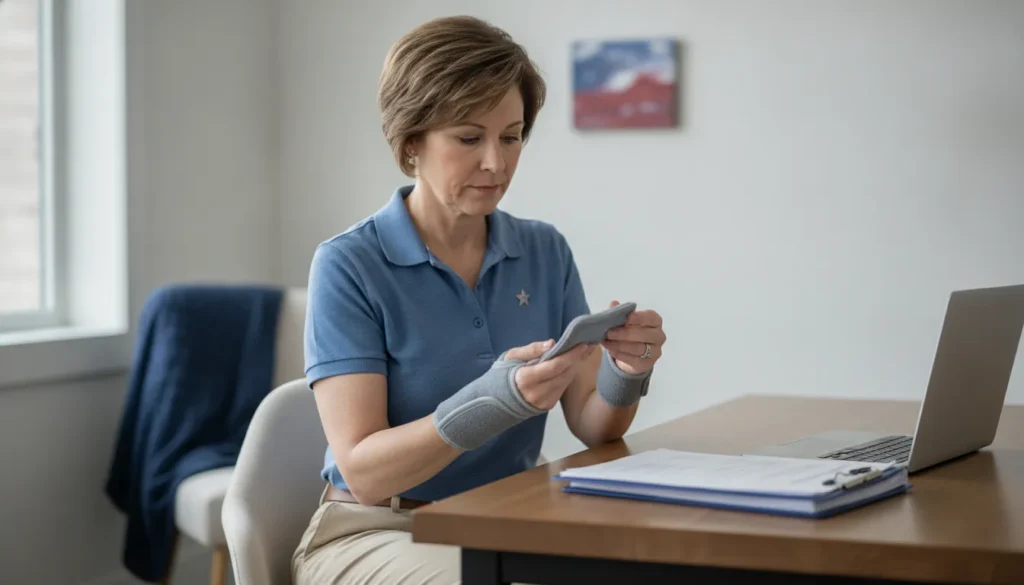
If you are searching for the VA rating for carpal tunnel, you are usually trying to answer one practical question: what evidence proves the numbness, pain, weakness, and work limits in your hand are serious enough for the rating you deserve? VA rates carpal tunnel syndrome under the peripheral nerve rules, and the details matter. The affected nerve, dominant hand, EMG or nerve conduction results, symptom frequency, grip strength, and job impact can all shape the final decision.
This guide breaks down the median nerve rating concepts in plain English. It is not legal advice and it does not replace a medical opinion. It is an evidence guide for veterans who want to prepare a stronger increase claim, secondary claim, or appeal after VA underrated their wrist and hand symptoms.
How VA Rates Carpal Tunnel Syndrome
Carpal tunnel syndrome happens when the median nerve is compressed at the wrist. The median nerve helps control sensation and movement in parts of the thumb, index finger, middle finger, and part of the ring finger. When that nerve is impaired, veterans may deal with numbness, tingling, burning pain, hand weakness, dropping objects, sleep disruption, and problems with repetitive hand use.
VA typically evaluates carpal tunnel under the peripheral nerve schedule in 38 CFR 4.124a. The median nerve criteria appear under Diagnostic Code 8515 for paralysis, with related codes for neuritis and neuralgia. In everyday claim language, most carpal tunnel cases are discussed as mild, moderate, or severe incomplete paralysis of the median nerve.
That phrase can sound dramatic, but incomplete paralysis does not always mean the hand is useless. It means the nerve is not functioning normally, but there is still some remaining function. VA is supposed to look at how much sensory loss, pain, weakness, motor impairment, and functional limitation the nerve condition causes.
Median Nerve Rating Concepts Veterans Need to Know
The median nerve rating schedule separates complete paralysis from incomplete paralysis. Complete paralysis is the highest-severity category and is usually reserved for major loss of hand function. Many carpal tunnel claims fall into incomplete paralysis because the veteran still has movement, but the nerve symptoms are limiting and persistent.
For median nerve incomplete paralysis, the basic severity levels are:
- Mild: Symptoms are usually sensory, such as tingling, numbness, or intermittent pain, with limited objective weakness.
- Moderate: Symptoms are more consistent or functionally limiting, often involving pain, numbness, reduced grip, reduced dexterity, or abnormal testing.
- Severe: Symptoms show major functional loss, more significant weakness, muscle changes, marked sensory loss, or substantial work and daily-life limits.
The schedule does not give a perfect checklist for mild versus moderate versus severe. That is why evidence quality matters. If your file only says “numbness in hand,” VA may underrate the condition. If your evidence shows nightly symptoms, positive nerve tests, reduced grip strength, trouble using tools, missed work, failed conservative treatment, and a doctor’s explanation, the rating picture is stronger.
Dominant Hand Versus Non-Dominant Hand
VA often rates upper-extremity nerve conditions differently depending on whether the affected hand is dominant or non-dominant. The rating schedule calls these the major and minor extremities. For most veterans, the major extremity is the dominant hand used for writing, tools, weapons training, computer work, and most fine motor tasks.
This can matter in a carpal tunnel claim because median nerve ratings are generally higher for the dominant hand at the more serious severity levels. If both wrists are affected, each side may be evaluated separately, and the combined rating is then calculated under VA math. That combined result is not simple addition, which is why the final percentage can surprise veterans.
If you are unsure how multiple ratings combine, use the VA Disability Calculator as a starting point. It helps you estimate how individual ratings may interact before you file an increase or secondary claim.
Why EMG and Nerve Conduction Evidence Matters
Electromyography and nerve conduction studies are not required in every carpal tunnel claim, but they can be powerful evidence. These tests can show whether the median nerve is conducting signals normally and whether the impairment is mild, moderate, or severe from a medical standpoint.
Strong test evidence may include:
- Abnormal nerve conduction velocity across the wrist
- Delayed median nerve latency
- Evidence of sensory or motor involvement
- Doctor interpretation that matches your symptoms
- Comparison between right and left hands
- Progression from earlier testing, if you are seeking an increase
Do not assume the test report speaks for itself. VA raters are reviewing a large file. A clear medical note that connects the EMG findings to your real limitations can make the evidence easier to understand. The best file usually has both objective testing and plain-language functional details.

Symptoms That Can Support a Higher Carpal Tunnel Rating
VA should consider more than the name of the diagnosis. A diagnosis tells VA what condition exists. The rating should reflect how severe the condition is and how much it limits function. That is where symptom evidence becomes important.
Relevant symptoms can include:
- Numbness or tingling in the thumb, index, middle, or ring finger
- Burning pain in the wrist, palm, or fingers
- Symptoms that wake you at night
- Reduced grip strength
- Dropping cups, tools, phones, or small objects
- Difficulty buttoning clothing, writing, typing, or using a mouse
- Hand fatigue during repetitive work
- Need for braces, injections, therapy, medication, or surgery
- Flare-ups after tool use, driving, computer work, or vibration exposure
Specificity beats broad statements. “My hand goes numb” is less useful than “my right hand goes numb after 15 minutes of typing, I drop tools twice a week, and wrist pain wakes me three nights per week.” VA needs severity, frequency, duration, and functional impact.
Work Limitations Can Be the Missing Evidence
Many veterans under-document how carpal tunnel affects work. That is a mistake. Work limitations often show the real severity of the nerve condition, especially for veterans in mechanic, warehouse, construction, healthcare, transportation, law enforcement, IT, administrative, or manufacturing jobs.
Document limits such as:
- Reduced ability to use hand tools or power tools
- Trouble typing, clicking, writing, or using a phone
- Slower task completion because of hand numbness
- Breaks needed to shake out the hand or rest the wrist
- Safety concerns when grip fails
- Lost overtime, reassignment, reduced hours, or missed work
- Difficulty with lifting, carrying, or repetitive motion
If carpal tunnel contributes to an inability to maintain substantially gainful employment, it may also interact with other VA benefit strategies. Veterans with serious combined limitations should read our Individual Unemployability VA Claims Guide and discuss the full disability picture with a qualified advocate or coach.
Direct Service Connection Versus Secondary Service Connection
A carpal tunnel claim may be filed as a direct service connection claim, an increase for an already service-connected condition, or a secondary service connection claim. The right path depends on your facts.
Direct service connection
Direct service connection usually requires evidence of a current diagnosis, an in-service event or onset, and a medical nexus connecting the current carpal tunnel syndrome to service. Examples may include repetitive hand use, vibration exposure, occupational duties, wrist trauma, or symptoms that began during active duty and continued after separation.
Increase claim
If VA already granted service connection for carpal tunnel but assigned a rating that no longer matches your symptoms, the issue is usually an increase. For an increase, focus on worsening symptoms, updated testing, treatment history, functional loss, and current work impact.
Secondary service connection
Secondary service connection applies when a service-connected condition causes or aggravates another condition. For example, a service-connected wrist, elbow, shoulder, neck, diabetes-related neuropathy, or other upper-extremity issue may be relevant depending on the medical facts. Secondary claims need a clear medical explanation, not just a theory.
VA’s own evidence guidance explains that claims are stronger when veterans submit medical records, supporting statements, and other relevant proof. You can review VA’s general evidence guidance at VA.gov. For a broader coaching perspective, read our VA Disability Coach for Secondary Claims Guide.
Checklist: Evidence to Gather Before Filing
Use this checklist before filing a VA rating increase, secondary claim, or appeal for carpal tunnel syndrome:
- Current diagnosis: Confirm carpal tunnel syndrome or median nerve impairment is documented in your medical records.
- EMG or nerve conduction results: Include the full report, not just a summary, if testing was completed.
- Dominant hand notation: Make sure the record clearly states whether the affected hand is your dominant hand.
- Symptom log: Track numbness, pain, weakness, nighttime symptoms, flare-ups, and how often they happen.
- Grip and dexterity evidence: Document dropping objects, reduced hand strength, trouble writing, tool use problems, or typing limits.
- Treatment history: List braces, medication, injections, therapy, surgery, specialist visits, and failed conservative care.
- Work impact: Gather supervisor statements, attendance records, job modifications, reduced hours, or task restrictions if available.
- Lay statements: Ask a spouse, coworker, or fellow veteran to describe what they actually see you struggle with.
- Nexus opinion: For direct or secondary claims, get a medical opinion that explains the connection using your actual records.
- Prior VA decision: If appealing or increasing, compare VA’s stated reasons against your current evidence.
Common Mistakes That Lead to Low Ratings
Carpal tunnel claims often get underrated because the evidence is too thin or too generic. Avoid these mistakes:
- Relying only on the diagnosis. VA rates severity, not just the existence of carpal tunnel.
- Ignoring the dominant hand issue. The major versus minor extremity distinction can affect the rating.
- Submitting test results without context. EMG evidence is stronger when a doctor explains functional impact.
- Leaving out work limitations. Job impact can demonstrate real-world severity.
- Underreporting flare-ups. Veterans often describe a good day at the exam and forget the bad days that drive impairment.
- Filing a secondary theory without a nexus. Secondary claims need a medical connection, not just a possible relationship.
The same evidence discipline applies across many VA rating claims. If you are building a larger increase strategy involving joint pain, nerve symptoms, or multiple conditions, our Knee Pain VA Rating Guide shows how range of motion, functional loss, and exam details can change the outcome.
FAQ: VA Rating for Carpal Tunnel
What is the typical VA rating for carpal tunnel?
There is no single automatic rating. VA evaluates carpal tunnel based on the affected median nerve, severity level, and whether the dominant or non-dominant hand is involved. Many cases are rated as mild, moderate, or severe incomplete paralysis.
Can EMG evidence increase my VA carpal tunnel rating?
EMG and nerve conduction studies can help, especially when they show objective median nerve impairment. They are strongest when paired with medical notes and lay evidence explaining grip weakness, numbness, pain, and work limitations.
Does VA rate both hands separately for carpal tunnel?
VA may rate each affected upper extremity separately when both hands are service connected. The final combined rating is calculated under VA math, so two separate ratings do not simply add together.
Can carpal tunnel be secondary to another service-connected condition?
It can be argued as secondary when medical evidence shows a service-connected condition caused or aggravated the carpal tunnel or median nerve impairment. The key is a clear medical nexus based on your records.
Bottom Line
The VA rating for carpal tunnel depends on more than a diagnosis. The strongest claims show the full picture: median nerve involvement, dominant hand status, EMG or nerve conduction findings, symptom frequency, grip and dexterity loss, treatment history, and work limitations. If VA only sees a short diagnosis note, the rating may not reflect what you live with every day.
Veterans Educating Veterans helps veterans understand the VA claims process through an educational, veteran-to-veteran coaching model. You Only Pay When You Get Paid. If you are preparing a carpal tunnel increase, secondary claim, or appeal, contact Veterans Educating Veterans to learn how the Inner Circle process can help you organize the evidence before you file.